


 Author: Dan Kuang
One of the most important indicators of gender (in)equality is the pay gap[1], which measures raw and unadjusted differences in pay between men and women. Closing the pay gap has been one of the most notable social passion projects; considerable legislative actions and social movements have been leveraged to address this issue. Over time, the pay gap has slowly closed—starting from a high of 57% in 1973 to an estimate of 84% in 2024.[2]
What is driving the pay gap? Why is closing it so challenging? The pay gap is highly sensitive to labor market fluctuations and disruptions. Understanding the effects of major labor market events is essential for addressing the gap. Within the past five (5) years, the US labor market has been impacted by two major disruptions: (1) the COVID-19 pandemic and (2) generative Artificial Intelligence (AI). How has this seismic double-tap affected the pay gap?
A recent report[3] by ResEcon provides extensive research on this very question (see attached). The researchers compared and contrasted male-dominated and female-dominated occupations over a five (5) year period (2019 to 2023) on job posting salary and volume data. The results they uncovered suggest that (1) there was relative stability at the overall level, but (2) there were considerable disruptions at the occupation level caused by COVID-19 and AI in both job posting salaries and volumes. What about the impact of COVID-19 and AI on the pay gap? In this case, the devil is indeed in the details; you can scroll to the last section to find out. While readers are encouraged to review the original study, it may be complex. Here are some key takeaways from that study:
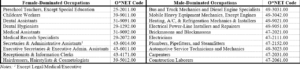
Table 1
Identified Female and Male Dominated Occupations
COVID-19: Uneven Impact Across Occupations
The pandemic did not affect men and women equally. In their comparison of selected female-dominated and male-dominated occupations, the research found that occupation-specific conditions mattered more than gender alone.
Female-Dominated Jobs: Roles requiring close physical contact were initially disrupted. Dental hygienists’ advertised salaries fell 5.9% from 2019 to 2020, when nonessential dental procedures were delayed, but then increased by 22.9% from 2020 to 2021 as demand returned.
Some essential caregiving roles experienced rising demand. Childcare workers’ advertised salaries increased 62.9% between 2019 and 2023. Their posting volume grew by 196.7% over the full period, possibly indicating worker shortages and greater recruitment efforts.
Male-Dominated Jobs: Across the ten selected male-dominated occupations, the average advertised salary declined from 2019 and 2023. Results varied by occupation, but the overall trend was downward.
Overall: Contrary to some research, this study does not support a simple conclusion that COVID affected all women more than men, or vice-versa. Instead, the measured effects depended heavily on the nature of each occupation. Female-dominated work involving dental care, childcare, clerical work, or caregiving faced different pressures, just as male-dominated construction and skilled trades produced varied outcomes.
Generative AI: Occupational AI Exposure
AI Exposure: Consistent with much of the existing research, the study found that AI exposure played a key role in posted salary and volume. For example, generative AI has a more direct impact on female-dominated clerical occupations more directly than male-dominated skilled trades. Secretaries and administrative assistants saw a 19.3% drop in advertised salaries in 2022, with job postings down by 34.7% from 2022 to 2023. Receptionist and information clerk postings declined by 37.4% in 2023. Taken together, jobs with high AI exposure experienced declines in both posted salaries and volume.
In contrast, female-dominated jobs that are not AI-exposed (e.g., dental hygienists, childcare workers) generally experienced upticks in both posted salaries and volume for 2022 to 2023. Male-dominated jobs in construction and repair involve physical, hands-on tasks that are less exposed to generative AI. Their salaries and posting volumes fluctuated, but changes are more likely tied to broader labor-market conditions than to technological disruption.
Pay Gap Trends
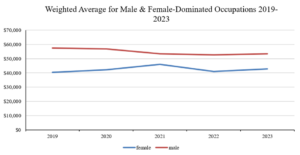
The chart in Figure 1 neatly summarizes the study—it displays average posted salaries by male and female dominated occupations between 2019 and 2023. Several notable features:
- Both male and female salary trends remained relatively stable and were largely unaffected by COVID-19 during the 2020-2021 period.
- Both male and female lines appear mostly flat and largely unaffected by generative AI during 2022-2023 period.
Digging into the numbers, several important observations related to the pay gap emerge:
- The difference in average posted salaries between male- and female-dominated occupations between 2019 ($17,067) and 2023 ($10,647).
- The unadjusted pay ratio for the occupations in the study increased from 2019 (70.3%) to 2023 (80.1%). The unadjusted pay gap closed by 9.8 percentage points.
Figure 1
Advertised Salary—Male and Female Dominated Occupations
Conclusion
The gender pay gap is shaped by more than just differences in pay among jobs. It is deeply influenced by the types of jobs men and women hold, as well as recent events like COVID-19 and AI have affected the labor market. While the gap has narrowed in some areas, understanding the underlying causes is crucial for making effective progress. The study takes an important step in that direction—investigating the effects of COVID-19 and AI at the occupation level among disparate jobs (male- and female-dominated occupations). The study uncovered immense complexity of occupational level changes that are often masked by aggregate pay gap figures.
Employers and policymakers should focus on both the roles people perform and the broader market forces at play to ensure fair and equitable compensation. By paying attention to occupational segregation and regularly reviewing pay practices, organizations can take meaningful steps toward closing the gap and building more inclusive workplaces.
Read the Full Research Paper: 261118a_COVID_AI_PayGap
[1] The gender pay gap is often presented as percentage of female earnings relative to males; sometimes referred to as the Gender Pay Ratio = . In1973, the pay ratio was 57%, meaning women were earned 57 cents for every dollar earned by men.
[2] https://www.pewresearch.org/short-reads/2025/03/04/gender-pay-gap-in-us-has-narrowed-slightly-over-2-decades/
[3] Vukadinovich, S., Healy, R.M., & Kuang, D. (2026). Occupational Segregation, Labor Market Disruptions, and The Gender Pay Gap [White paper]. Resolution Economic, LLC. https://www.resecon.com